Managed IT
The day-to-day, handled before you notice it. One service desk, one monitoring platform, one patch schedule and one monthly report covering every asset you own.
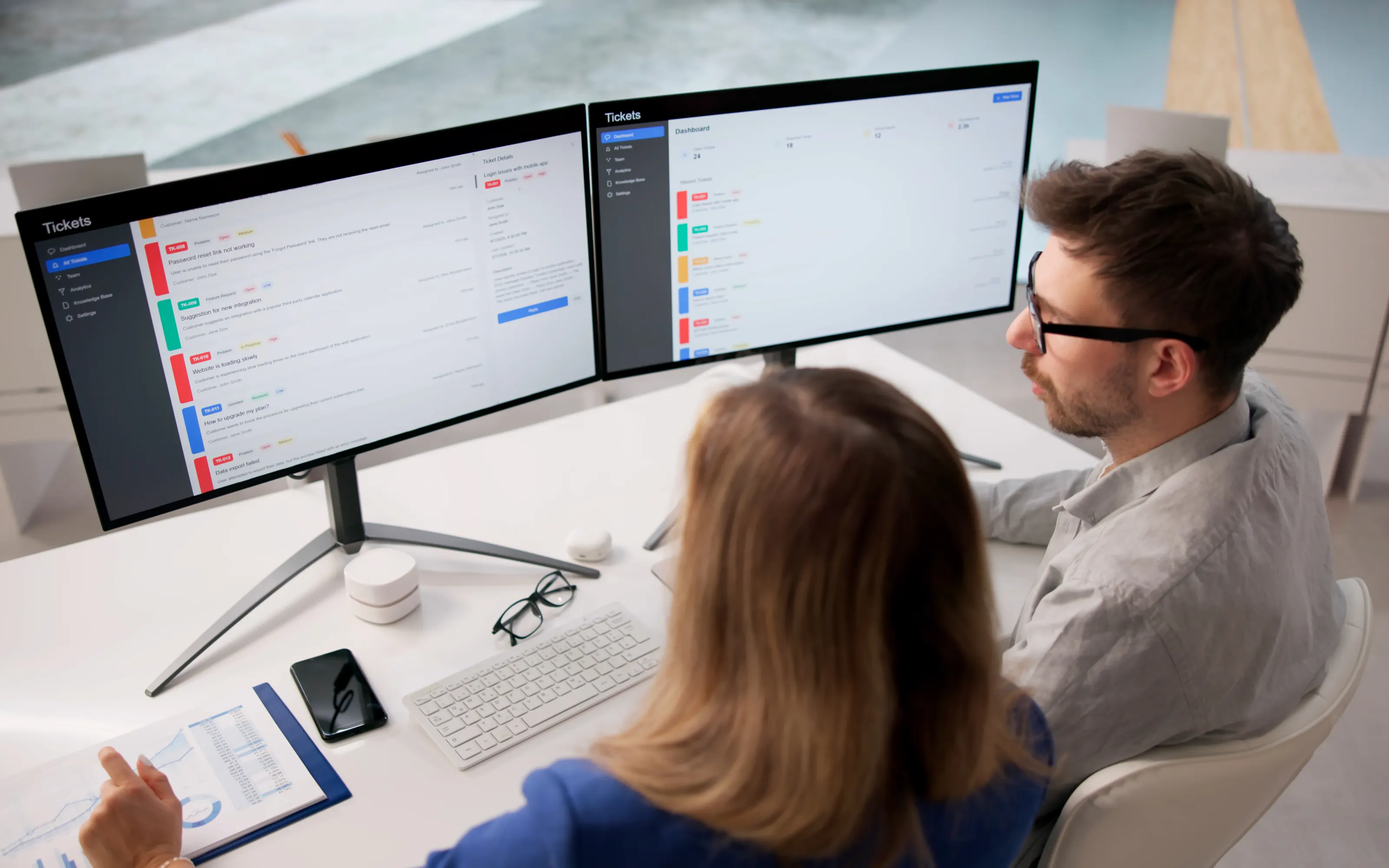
Break-fix support earns more when things break
An hourly provider makes money when your environment misbehaves. That is simple arithmetic, and it explains why the patching and the documentation keep slipping to next week.
We are paid a fixed amount per seat per month. Every ticket we prevent is time we get back, so preventing them is the whole business model. It also means you can raise a ticket for something small, and the only conversation is about fixing it.
What that looks like in practice: patch compliance reported monthly, an asset register that matches reality, documentation written as the work happens, and a quarterly review where we go through the ticket data with you.
Nine things, every month, for every seat
Each item below is part of the base agreement and covered by the per-seat price.
- Service desk
- Unmetered support by phone, email and portal for every user. Australian-based engineers, business hours as standard and 24/7 on the Complete tier and above. Tickets are triaged, categorised and reported on — you can see what your people are actually asking for.
- Monitoring & alerting
- Agents on servers, endpoints and network devices watching disk, memory, service health, certificate expiry, backup status and hardware warnings. Alerts route to a person who reads them and acts.
- Patch management
- Operating system and third-party application patching on a defined schedule, with a test ring before general release, a documented exception process and a compliance percentage reported monthly against the Essential Eight timeframes.
- Endpoint protection
- Next-generation antivirus and EDR deployed, tuned and monitored. We investigate detections ourselves and bring you the outcome.
- Identity & access administration
- Onboarding, offboarding and role changes handled to an agreed checklist, including licence assignment, group membership, mailbox delegation and — critically — the revocation steps that usually get missed when someone leaves.
- Network & connectivity
- Firewall, switching and wireless configuration, firmware currency, VPN and remote access, plus liaison with your carrier when the fault turns out to be theirs.
- Server & infrastructure
- On-premises, co-located and Azure workloads: capacity, health, patching, certificate lifecycle and end-of-life tracking, so hardware and operating systems are replaced on a plan, ahead of failure.
- Vendor management
- We deal with your line-of-business software vendors, your ISP and your printer company on your behalf, and we keep the ticket open on our side until it is resolved on theirs.
- Documentation & reporting
- A living runbook of your environment, an asset register, and a monthly report covering tickets, patch compliance, backup success, security posture and anything we want to raise before it becomes a project.
Measured against the hire you would otherwise make
The real comparison is managed IT against putting someone on staff, and that hire costs a good deal more than the salary line suggests.
An advertised salary is roughly three quarters of what the position actually costs once superannuation, payroll tax, leave loading, recruitment, a desk and a laptop are added. What that money buys is one person with one set of skills, available for about nineteen per cent of the calendar — because nobody works nights, weekends, annual leave or the fortnight they are unwell. We set the whole calculation out separately, with every assumption shown.
For a comparable figure a managed agreement buys a whole team: a service desk that is staffed when your one hire is asleep, a specialist each for identity, networking and security, and the monitoring, patching and endpoint tooling already licensed across our whole client base, so you share the cost of it.
It also removes a risk that rarely reaches the business case. A single internal hire is a single point of failure who can resign, and the knowledge usually leaves with them.
- About 75%The advertised salary
- About 25%Super, payroll tax, leave loading, recruitment, a desk and a laptop
One internal hire40 of 168 hours
- Mon
- Tue
- Wed
- Thu
- Fri
- Sat
- Sun
Service desk, Complete tier168 of 168 hours
- Mon
- Tue
- Wed
- Thu
- Fri
- Sat
- Sun
A standard week, before annual leave, public holidays and sick days bring one person’s share of the year down to about 19 per cent. Business-hours cover is standard on every tier.
The savings are mostly in what stops happening
Some of it is on the invoice. Most of it is in the incidents, the downtime and the emergency call-outs that a maintained environment avoids.
- Paid to prevent tickets. A fixed monthly fee means the work we do to stop problems recurring is work we want to do, because it is the only way the model pays for us.
- Tooling at our scale. Monitoring, patch management, EDR and documentation platforms are licensed across the whole client base, which costs far less per seat than buying each one for a single business.
- Fewer outages to pay for. The cheapest hour of IT support is the one nobody needed. Patching, monitoring and tested backups are unglamorous precisely because they are working.
- Staffing is our problem. Hiring costs, resignations and vacant roles sit with us, and your work keeps moving throughout.
- Purchasing at trade, with the margin stated. Hardware and licences are sourced at cost plus a margin we tell you, so you can compare it against buying direct.
- A budget you can forecast. One number per seat per month, and project work quoted and approved before it starts.
What people ask before signing
How long does transition from our current provider take?
Four to six weeks for a typical 50–250 seat environment, longer for multi-site or regulated environments. We run in parallel with your incumbent for the first two weeks so the handover is independent of their goodwill, then cut over the service desk once documentation, monitoring and backup are verified on our side.
If your incumbent is uncooperative — it happens — we rebuild the documentation from the environment itself. It takes longer, and we will tell you upfront if that is what we are looking at.
Do we have to replace our existing tools?
Case by case. We keep standards because one well-supported antivirus product beats eleven supported badly, but if you have a tool that works and your team knows it, we will assess it on merit and tell you honestly whether replacing it is worth the disruption.
Is support genuinely unlimited?
Yes. Raise as many tickets as you need, including the small ones; there is no ticket allowance or block-hour drawdown. Project work such as a migration or an office move is quoted and approved before it starts, so you see the cost and sign off on it in advance.
What happens if we want to leave?
Twelve-month initial term, then month to month with 60 days' notice. Exit assistance is priced in the agreement before you sign it: documentation handover, tenant admin transfer, agent removal and a knowledge transfer session with the incoming provider. Your data and documentation are yours throughout.
Who actually answers the phone?
An engineer in Australia who has access to your documentation. On the Fortified tier you also get a named technical account manager who already knows your environment.
See your environment the way we would
A fixed fee and a written position, yours to keep whatever you decide next.